
The Wilson Blade 98 V9 (2024) and Wilson Blade 98 V8 (2021) are two of the most popular control-oriented tennis rackets of recent years.
Both rackets are designed for intermediate to advanced players who want excellent feel, precision, and spin.
While the two frames share the same 98 sq in head size and similar specifications, Wilson made several refinements to the V9 to improve stability and give it a more solid, connected feel. Both have since been succeeded by the Blade V10, released in April 2026, which I cover briefly below.
In this guide, I’ll compare the Blade 98 V9 and V8 in detail, including specs, performance, and which version is the better choice for your game.
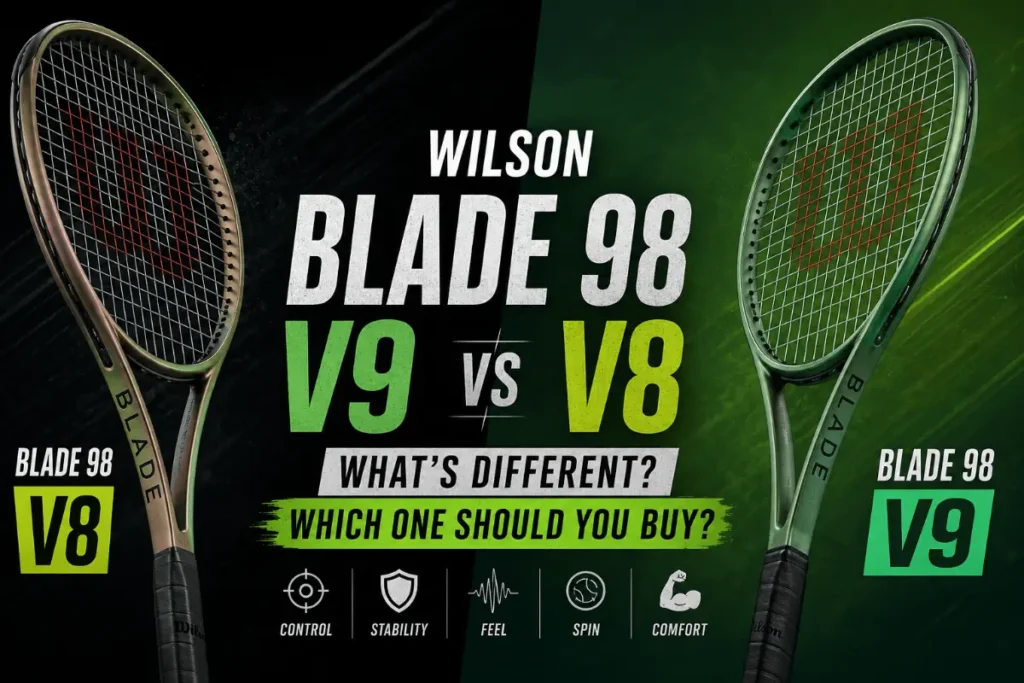
Wilson Blade 98 V9 vs V8 (Quick Answer)
The Wilson Blade 98 V9 is a more refined version of the V8, with better stability and a more solid feel on off-center shots. The V8 has the more classic, flexible Blade feel.
The Blade 98 V8 remains an excellent racket. Now that it is two generations old, it is mostly found used or as old stock, often at a big saving.
Between the two, the V9 is the better overall racket. Since both are now previous-generation frames, price and condition matter more than the small spec differences. If you want the newest Blade, look at the V10 instead.
What About the Wilson Blade V10?
Wilson released the Blade V10 in April 2026, replacing the V9. The main changes are a hoop beam that is 1 mm taller, a new TurboTaper beam design, an updated StableFeel+ layup and tighter manufacturing tolerances. Wilson positions it as a slightly more powerful Blade that keeps the classic control focus.
If you want the latest frame, the Blade V10 is the one to buy. If you prefer the classic, lower-powered Blade feel, or find a V9 at a clearance price, the V9 is still a very good option. If you are also weighing up head size, see our Blade 100 vs Blade 98 comparison (V10 and V9).
Wilson Blade 98 V9 vs V8 Specifications
Blade 98 16×19 Comparison
| Specification | Blade 98 V9 | Blade 98 V8 |
|---|---|---|
| Head Size | 98 sq in | 98 sq in |
| Length | 27 in | 27 in |
| Weight (Unstrung) | 305 g | 305 g |
| Weight (Strung) | 323 g | 323 g |
| Balance (Unstrung) | 32 cm / 7 pts HL | 32 cm / 7 pts HL |
| Balance (Strung) | 33.0 cm / 4 pts HL | 32.6 cm / 5 pts HL |
| String Pattern | 16×19 | 16×19 |
| Beam Width | 21 mm | 21 mm |
| Stiffness (RA) | 62 | 61 |
| Swingweight (Strung) | 324 | 328 |
| Composition | Braided graphite + basalt | Braided graphite + basalt |
| Technology | FortyFive°, StableFeel, DirectConnect | FortyFive°, DirectConnect |
| Recommended String Tension | 50–60 lbs | 50–60 lbs |
On paper, the two rackets are extremely similar. The V9 is slightly stiffer and has a lower strung swingweight (324 vs 328), while the weight, head size and beam are unchanged. Specs are manufacturer/retailer figures, and individual frames can vary slightly.
Blade 98 18×20 Comparison
| Specification | Blade 98 18×20 V9 | Blade 98 18×20 V8 |
|---|---|---|
| Weight (Unstrung) | 305 g | 305 g |
| Balance (Strung) | 33 cm / 4 pts HL | 33 cm / 4 pts HL |
| Swingweight (Strung) | 330 | 327 |
| Stiffness (RA) | 60 | 60 |
| Beam Width | 21 mm | 21 mm |
The 18×20 versions follow the same pattern: near-identical specs, with StableFeel the main change. The denser pattern gives a lower, more controlled ball flight and less spin than the 16×19, so it suits flatter hitters who want maximum precision.
What Changed in the Blade V9?
Wilson introduced several updates with the Blade V9:
StableFeel Technology
The most significant change is StableFeel, which improves torsional stability and gives the racket a more solid response on off-center shots.
A More Solid Feel
Wilson describes StableFeel as a slightly firmer layup, and the V9’s stiffness is a point higher (RA 62 vs 61). Reviewers are split on how that feels, but most agree the V9 feels more solid and stable at contact while keeping the classic Blade control and feedback.
New Emerald Green Cosmetic
The V9 features a matte emerald green finish, replacing the color-shifting green-to-copper finish of the V8.
Redesigned Bumper and Grommets
The V9 uses a redesigned clip-in bumper and grommet system that is easier to replace. It does not affect performance.
How to Tell a Blade V8 From a V9
If you are buying used, the quickest way to identify the version is the cosmetic and the bumper system:
- Blade V8 (2021): color-shifting paint that moves between green and copper depending on the light.
- Blade V9 (2024): a uniform matte emerald green finish and the redesigned clip-in bumper and grommet system.
- Blade V10 (2026): a brighter “championship green” finish with a red hot spot on the hoop and embossed “muscle lines” on the frame.
When buying second-hand, ask for clear photos of the whole frame, including the throat and bumper, and check for cracks or heavy bumper wear before you pay.
Performance Comparison
On court, the differences are small. Here is how the two frames compare across the main categories:
| Category | Blade 98 V9 | Blade 98 V8 | Edge |
|---|---|---|---|
| Control | Excellent | Excellent | Tie |
| Feel | More solid at contact | Classic, flexible Blade feel | Preference |
| Stability | Twists less on off-center hits and against pace | Good, but slightly less stable | V9 |
| Spin | Same head size and 16×19 pattern | Same head size and 16×19 pattern | Tie |
| Power | Low; may feel fractionally livelier | Low | Tie |
| Comfort | Flexible (RA 62) | Flexible (RA 61) | Tie |
| Maneuverability | Lower swingweight (324) | Swingweight 328 | Slight edge V9 |
The clearest on-court difference is stability. It is most noticeable when returning serve or absorbing pace from heavy hitters. Control, spin and power are effectively the same, and both rackets reward full, fast swings.
Feel is more subjective. Wilson describes StableFeel as a slightly firmer layup, but reviewers are split: some find the V9 firmer, while others describe it as more dampened. Most agree it feels more solid at contact.
Which Racket Feels Better?
This depends on your preferences.
Choose the Blade 98 V8 if you like:
- The classic, flexible Blade feel
- A slightly higher swingweight (328)
- Better value (used or old stock)
Choose the Blade 98 V9 if you prefer:
- A more solid response
- Better stability
- Lower swingweight
Wilson Blade 98 V9 vs V8: Playtest Summary
After hitting with both frames, the overall performance difference is relatively small.
The V8 feels a little more responsive and direct, while the V9 feels more polished and forgiving.
The V9 is the more refined racket, but it is not a dramatic upgrade.
Should You Upgrade from V8 to V9?
If you already own the Blade 98 V8 and enjoy it, there is no urgent need to upgrade.
The performance gains are incremental rather than transformational.
However, if:
- You want a more solid feel
- You need better stability
- You are buying a new Blade anyway
then the V9 is the better choice.
Should You Buy the V8 Instead?
Absolutely.
The Blade 98 V8 remains a great control racket. It is now two generations old, so you will mostly find it used or as old stock, often at a big saving.
For many players, the V8 offers very similar performance at a much lower price. Check the condition of used frames carefully.
Who Should Use the Wilson Blade 98?
Both versions are best suited to:
- Intermediate to advanced players
- Aggressive baseliners
- Players who generate their own power
- Competitors seeking precision and feel
Not ideal for:
- Beginners
- Players needing easy power
- Those wanting a very lightweight racket
If you like the Blade’s control but want a more arm-friendly frame, see our Clash 98 vs Blade 98 comparison. If you want a heavier, more stable player’s frame, our RF 01 vs Blade 98 V9 comparison is a good next step. For a wider range of options, see our guide to the best tennis rackets.
Pros and Cons
Blade 98 V9
Pros
- More solid feel
- Slightly better stability
- Premium feel
- Excellent control
Cons
- Replaced by the V10 in 2026
- Upgrade is relatively small
Blade 98 V8
Pros
- Outstanding value
- Classic, flexible feel
- Tour-level control
Cons
- Slightly less stable
- Harder to find new
Frequently Asked Questions
Is the Wilson Blade V9 better than the V8?
Yes, but only slightly. The V9 offers improved stability and a more solid feel, but the differences are subtle.
Is the Blade V8 still worth buying?
Yes. The V8 is still a top-tier control racket and is usually much cheaper, though it is now mostly sold used or as old stock.
Does the Blade V9 have more power?
Not significantly. Both rackets are designed primarily for control.
Which racket is more comfortable?
There is little in it. Both are flexible frames (RA 61–62), and reviewers disagree on which feels softer. If you have arm problems, demo both before buying.
Which one offers better value?
The Blade V8 usually offers better value because of discounted pricing.
Final Verdict
The Wilson Blade 98 V9 improved on the V8 with small but meaningful gains in stability and a more solid feel. It has since been replaced by the Blade V10 (2026).
However, the Blade 98 V8 remains an outstanding racket and is one of the best value options for advanced players.
Buy the V9 if you want the more refined and stable of the two, especially at a clearance price.
Buy the V8 if you prefer a classic, flexible Blade feel at a lower price.
If you already own a V8 and enjoy it, there is no need to upgrade. If you want the newest Blade, look at the V10 instead.